
Master your heart health with our comprehensive guide to the Sodium in Salt Calculator. Learn the conversion formulas, understand daily limits, and discover hidden sodium sources today.
Sodium in Salt Calculator: The Complete Guide to 1 Critical Mineral
Salt is one of the most common ingredients in kitchens around the world. It makes food taste better, preserves ingredients, and plays a vital role in chemistry. However, there is often confusion between “salt” and “sodium.” While people use these words interchangeably, they are not the same thing. Understanding the difference is crucial for your health.
If you have ever looked at a nutrition label and felt confused by the numbers, you are not alone. This guide acts as a manual sodium in salt calculator, teaching you the math, the science, and the practical steps to manage your diet. By the end of this article, you will be an expert on how much salt you are actually eating.
Understanding the Basics: Salt vs. Sodium
Before we dive into calculations, we must define our terms. Table salt is a chemical compound known as sodium chloride (NaCl). It is made up of two different elements that bond together. This bonding creates the white crystals we shake onto our fries.
Sodium is a mineral. It is one of the chemical elements found in salt. Your body needs sodium to function. It helps your nerves send signals and helps your muscles contract. However, you only need a small amount. The problem arises when we consume too much sodium, which usually happens by eating too much salt.
The Ionic Compound Ratio
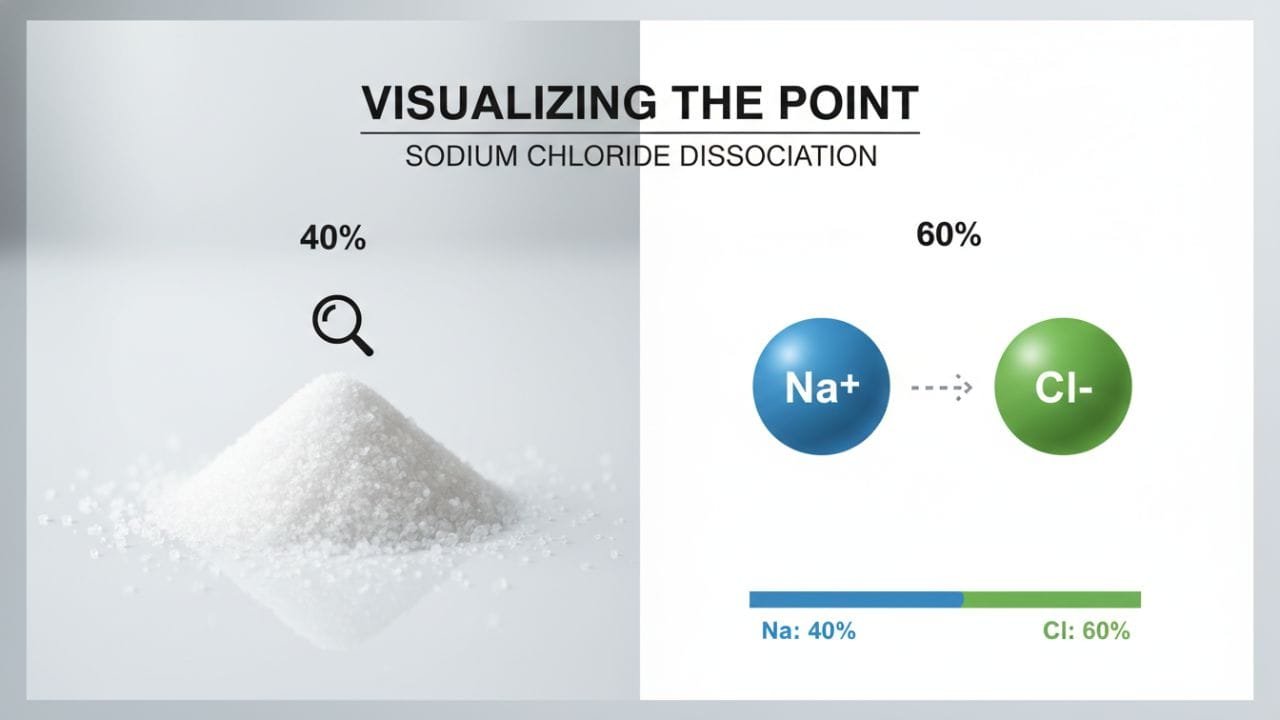
To understand the conversion, we must look at chemistry. Salt is an ionic compound. This means it is formed by ions held together by electric forces. The ionic compound ratio of sodium chloride is 1:1. This means for every one atom of sodium, there is one atom of chloride.
However, atoms have different weights. A sodium atom is lighter than a chloride atom. Because of this weight difference, sodium does not make up 50% of the weight of salt. Instead, the weight breakdown is roughly:
- Sodium: 40%
- Chloride: 60%
This 40/60 split is the magic number for all your calculations. It is the foundation of any sodium in salt calculator.
The Sodium Percentage in Salt
Knowing the sodium percentage in salt allows you to convert between the two. Since sodium is 40% of the total weight of table salt, you can use simple multiplication to find out how much sodium is in a specific amount of salt.
For example, if you have 1 gram of salt, you do not have 1 gram of sodium. You have 0.4 grams (or 400 milligrams) of sodium. This distinction is vital because health guidelines usually list limits in milligrams of sodium, while recipes list amounts in teaspoons of salt.
The NaCl Conversion Formula
You do not always need a digital tool if you know the math. The NaCl conversion formula is straightforward. There are two ways to look at this calculation: converting salt to sodium, and converting sodium to salt.
Converting Salt to Sodium
To find out how much sodium is in your salt, multiply the weight of the salt by 0.4.
Formula: Salt weight x 0.4 = Sodium weight
Converting Sodium to Salt
Sometimes, a doctor might tell you to limit sodium to a specific number, and you need to know how much salt that equals. To do this, you multiply the sodium amount by 2.5.
Formula: Sodium weight x 2.5 = Salt weight
For precise calculations on dietary requirements, you might find the tools at My Online Calculators incredibly useful for checking various health metrics alongside your manual math.
Sodium Chloride Conversion Table
To make things easier, here is a reference table. This table helps you visualize the sodium chloride conversion from common salt measurements to their sodium content.
| Salt Amount (Grams) | Approximate Teaspoons | Sodium Content (Milligrams) |
|---|---|---|
| 1 g | 1/6 tsp | 400 mg |
| 2.5 g | 1/2 tsp | 1,000 mg |
| 5 g | 1 tsp | 2,000 mg |
| 6 g | 1.2 tsp | 2,400 mg |
| 10 g | 2 tsp | 4,000 mg |
Milligrams to Grams: Mastering the Units
One of the biggest hurdles in tracking intake is unit confusion. Nutrition labels often list sodium in milligrams (mg), but we often buy food by the gram (g) or kilogram (kg). Mastering the milligrams to grams conversion is a necessary skill.
There are 1,000 milligrams in 1 gram. This means:
- 1,000 mg = 1 g
- 500 mg = 0.5 g
- 2,300 mg = 2.3 g
When you see a package that says “500 mg of sodium,” you should mentally convert that to half a gram of pure sodium. If you apply the salt conversion (multiply by 2.5), that represents 1.25 grams of table salt.
Daily Sodium Intake Guidelines
Health organizations around the world have established guidelines for daily sodium intake. These guidelines are designed to prevent chronic diseases. The numbers can vary slightly depending on where you live, but the consensus is clear: we are eating too much.
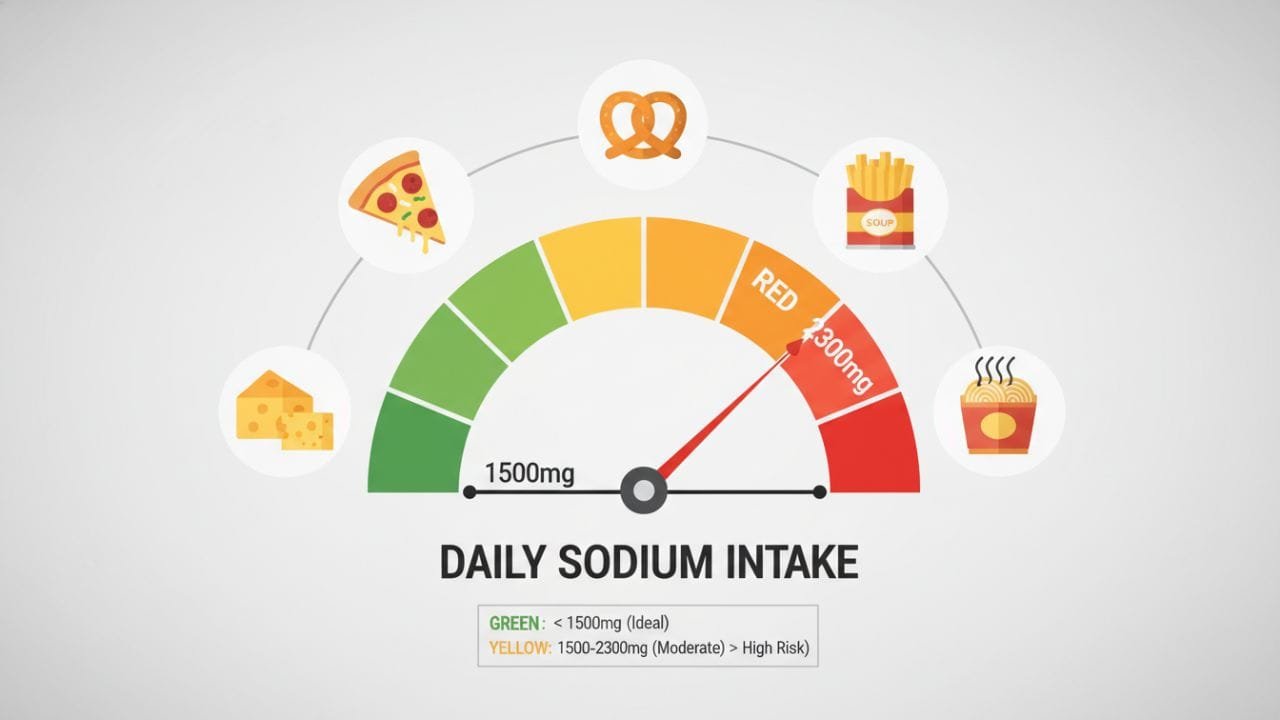
The World Health Organization (WHO) and other heart associations generally recommend consuming less than 2,000 to 2,300 milligrams of sodium per day. This is roughly equal to one teaspoon of table salt.
The Recommended Daily Allowance
The recommended daily allowance (RDA) is the maximum amount considered safe for the general population. For adults, the upper limit is often set at 2,300 mg per day. However, for specific groups, the limit is lower.
An “ideal” limit for most adults, especially those concerned with heart health, is often closer to 1,500 mg per day. This requires strict monitoring of what you eat. If you are struggling to track these small numbers, using a digital salt intake calculator can simplify the process.
High Blood Pressure and Health Risks
Why do we care so much about this mineral? The primary concern is high blood pressure, also known as hypertension. Sodium acts like a sponge for water. When you have excess sodium in your bloodstream, it pulls water into your blood vessels.
This extra water increases the volume of blood flowing through your veins and arteries. Imagine turning up the faucet on a garden hose; the pressure inside the hose increases. This is exactly what happens in your body.
Cardiovascular Health Implications
Over time, high blood pressure damages the walls of your arteries. This strain forces your heart to work harder to pump blood. This is a major risk factor for poor cardiovascular health. It can lead to heart disease, stroke, and heart failure. Additionally, excess salt can be hard on your kidneys, which are responsible for filtering out the excess sodium.
Reading the Nutritional Facts Label
The best weapon you have in this battle is the nutritional facts label found on packaged foods. Reading this label correctly is a skill that takes practice.
When you look at the label, find “Sodium.” It will list the amount in milligrams and usually a percentage of the Daily Value (%DV). The %DV is based on the recommended limit of 2,300 mg.
- Low Sodium: 5% DV or less per serving.
- High Sodium: 20% DV or more per serving.
Be careful with serving sizes. A bag of chips might look like a single snack, but the label might say the bag contains 3 servings. If you eat the whole bag, you must triple the sodium number.
Hidden Salt in Food
You might think, “I don’t use the salt shaker, so I am safe.” Unfortunately, this is rarely true. The vast majority of sodium we consume comes from processed and restaurant foods. This is known as hidden salt in food.
Manufacturers add salt for flavor, but also as a preservative and a texture enhancer. Bread, for example, does not taste salty, but it is a significant source of sodium simply because we eat so much of it. Other major sources include:
- Cured meats (bacon, ham, deli meat)
- Canned soups and vegetables
- Pizza and pasta sauces
- Cheese
- Salad dressings and condiments
Dietary Salt Limit: Who Needs to be Careful?
While everyone should monitor their intake, certain groups need to adhere to a stricter dietary salt limit. You should aim for 1,500 mg or less if you fall into these categories:
- You are age 51 or older.
- You are African American (this demographic is statistically more sensitive to salt).
- You have high blood pressure.
- You have diabetes.
- You have chronic kidney disease.
If you are unsure where you stand, calculating your intake is the first step. You can find various health calculators at Health Calculator to help assess your overall health risks and metrics.
Table Salt Measurement: Accuracy in the Kitchen
Cooking at home is the best way to control your salt intake, but table salt measurement can be tricky. Different types of salt have different densities. For example, a teaspoon of fine table salt packs more crystals than a teaspoon of coarse kosher salt.
Because the crystals of kosher salt are larger and irregularly shaped, there is more air in the spoon. Therefore, one teaspoon of kosher salt has less sodium than one teaspoon of table salt. However, if you measure by weight (grams), the sodium content is roughly the same.
Salt Type Comparison Table
| Salt Type | Weight per Teaspoon | Sodium per Teaspoon |
|---|---|---|
| Table Salt (Fine) | ~6 grams | ~2,300 mg |
| Kosher Salt (Diamond Crystal) | ~3 grams | ~1,120 mg |
| Kosher Salt (Morton) | ~4.8 grams | ~1,800 mg |
| Sea Salt (Coarse) | ~4-5 grams | ~1,500 – 2,000 mg |
Strategies for Sodium Reduction
Sodium reduction does not mean eating bland food. It means retraining your taste buds. It takes about 6 to 8 weeks for your palate to adjust to lower salt levels. Once you adjust, you will start to taste the natural flavors of the food itself.
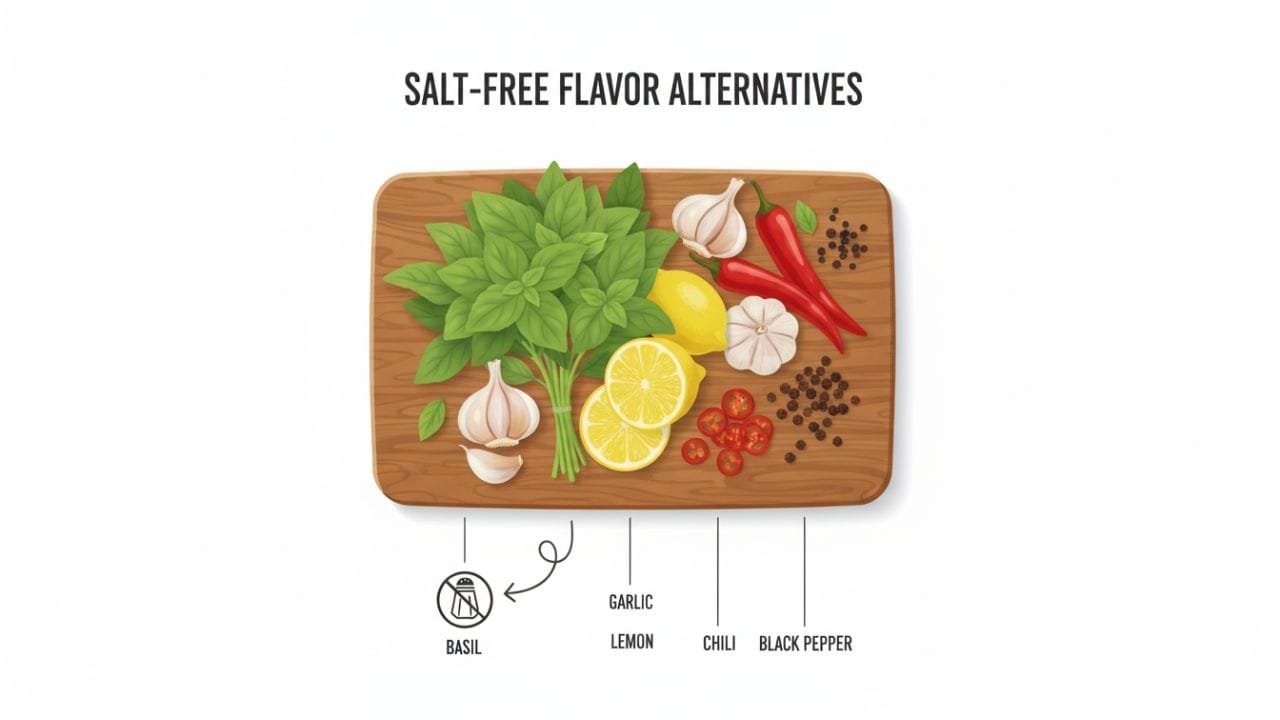
Start by rinsing canned vegetables and beans; this can remove up to 40% of the sodium. Use fresh herbs, spices, garlic, onions, and lemon juice to add flavor without the salt. Avoid instant noodles and pre-packaged rice mixes, which are notoriously high in salt.
Using a Salt Intake Calculator for Better Health
Technology can be a great ally. A salt intake calculator can help you log your food and see the totals accumulate throughout the day. Many apps allow you to scan barcodes on food packages. This automatically pulls the data from the nutritional facts label.
When you see the numbers add up, it becomes easier to make trade-offs. If you know you are going out for pizza tonight, you can choose a low-sodium breakfast and lunch to balance your day. For those who love data, resources like My Online Calculator provide excellent scientific calculators that can help with unit conversions and health tracking.
Conclusion
Managing your salt intake is one of the most effective ways to protect your long-term health. By understanding the difference between sodium and salt, mastering the math of the NaCl conversion formula, and reading labels effectively, you take control of your diet. Remember, small changes add up. Reducing your intake from 3,500 mg to 2,300 mg can have a profound impact on your blood pressure and heart health. Use the tools and knowledge provided here to make informed, healthy choices every day.
Technical Resources & References
To ensure the highest level of accuracy and authority, we have defined several technical terms used in this article. Please refer to these external resources for deep-dive definitions.
- Ion: An atom or molecule with a net electric charge due to the loss or gain of one or more electrons.
- Hypertension: A long-term medical condition in which the blood pressure in the arteries is persistently elevated.
- Electrolyte: Minerals in your body that have an electric charge, essential for balancing water and pH levels.
- Atomic Mass: The mass of an atom of a chemical element expressed in atomic mass units.
- Molar Mass: The mass of a sample of that compound divided by the amount of substance in that sample, measured in moles.