


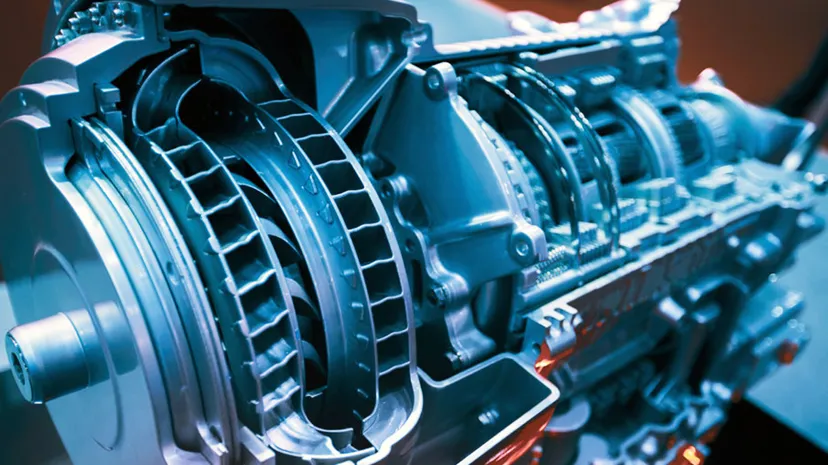


The transmission is often the unsung hero of the modern vehicle, acting as the silent conductor of an intricate mechanical orchestra. While the engine generates the raw energy required for movement, it is the transmission that translates that volatile energy into controlled, usable power at the wheels. Without this component, even the most powerful engine would be virtually useless. To understand how a car transmission works, one must first understand the limitations of an internal combustion engine and the delicate balancing act it performs every second.
An engine operates within a specific revolutions-per-minute (RPM) range, often referred to as the “sweet spot.” If the engine’s RPM falls too low, the vehicle loses momentum and stalls out. Conversely, if the RPM climbs too high, the engine reaches a point of diminishing returns where mechanical stress increases while power output significantly drops off. Because of these constraints, an engine cannot be connected directly to the wheels. If it were, the wheels would force the engine out of its optimal range almost immediately upon starting from a standstill or reaching highway speeds.
The transmission serves as the essential bridge between the engine and the road. By utilizing a sophisticated set of gears, it ensures the engine stays within its required range regardless of the vehicle’s speed. This guide will explore the different mechanical approaches to this problem, providing a comprehensive look at how a car transmission works to keep you moving efficiently through every gear change.
The Mechanical Bicycle: Understanding Gear Ratios
To grasp the fundamental mechanics of a transmission, it is helpful to imagine riding a multi-speed bicycle. When climbing a steep hill, a cyclist selects a low gear—utilizing a small gear at the crank (the pedals) and a larger gear at the wheel. This configuration requires more pedal cycles to move forward, but the physical effort required for each rotation is relatively easy. If those gears are reversed for a flat sprint, the cyclist achieves faster progress with fewer pedal cycles, but the effort required to move the pedals increases significantly.
This is the core concept of a “gear ratio.” Technically defined, a gear ratio is the number of rotations between two connected gears. A transmission is essentially an entire set of different-sized gears housed together, allowing the vehicle to choose the appropriate ratio for any given driving situation.
“Pull together an entire set of different size gears to be able to choose the right ratio for the situation and you have a transmission.”
Manual vs. Automatic: How a Car Transmission Works in Practice
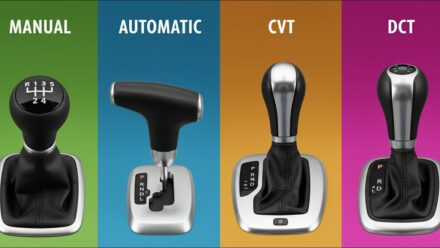
The two most traditional methods of power transfer involve either direct driver engagement or automated hydraulic systems. Each offers a unique way of managing the engine’s power.
Manual Transmissions and the Clutch
A manual transmission relies entirely on the driver to manage power delivery. This is achieved through a gear selector and a foot-operated clutch. When a driver needs to change gears, they press the clutch pedal, which mechanically pries the engine’s flywheel apart from the transmission. This temporary disconnection allows the driver to select a different gear ratio before re-engaging the engine. This mechanical separation is also what prevents the engine from stalling when the vehicle comes to a complete stop.
Automatic Transmissions and the “Two Fan” Analogy
An automatic transmission handles gear selection at the optimal time without driver input. Instead of a mechanical clutch, these systems typically use a torque converter. The torque converter functions like two fans placed face-to-face in a housing filled with hydraulic fluid. One fan is attached to the engine, and the other to the transmission.
As the first fan spins, the movement of hydraulic fluid drives the blades of the second fan. This fluid circulation multiplies the torque coming from the engine, acting almost like an additional low gear ratio. While there is some energy loss during this process, it allows the vehicle to stop without stalling. Modern torque converters often include a “lock-up” clutch that engages during cruising speeds. This creates a 1:1 mechanical connection, eliminating the slight “slip” of hydraulic fluid to maximize fuel efficiency. Following the torque converter, the system uses planetary gears to mechanically adjust RPM and torque.
CVT Evolution: How a Car Transmission Works Without Fixed Gears
The Continuously Variable Transmission (CVT) represents a departure from traditional fixed gear sets. Among the different types of transmissions, CVT systems are unique because they replace physical gears with a flexible belt and two pulleys—one linked to the engine and one to the wheels. By adjusting the width of these pulleys, the CVT can provide near-infinite gear ratios.
However, traditional CVTs can sometimes feel “sluggish” when accelerating from a stop. Toyota’s Direct Shift CVT addresses this by incorporating a physical “launch gear.” This provides the confident, responsive feel of a traditional first gear. Once momentum is established, the system transitions to the belt and pulley system, simulating nine additional gear ratios to maintain efficiency and a smooth ride across all speeds. Understanding this transition is key to seeing how a car transmission works to balance performance with economy.
Hybrid Transmissions: The Power Split Device
Hybrid vehicles require a specialized approach because they manage two power sources: a combustion engine and electric motors. A hybrid CVT trades the traditional flexible belt for a “Power Split Device” consisting of planetary gears and electric motors.
This system does more than just select a speed range; it seamlessly blends engine power with electric motor power. By replacing the belt with a Power Split Device, the system provides instant torque response from the electric motors whenever the accelerator is pressed. Additionally, this setup allows the vehicle to run in full electric mode under certain conditions, significantly increasing overall efficiency.
Transmission Comparison Matrix
| Transmission Type | Key Component | Primary Benefit |
| Manual | Clutch and Flywheel | Direct driver control and mechanical engagement. |
| Automatic | Torque Converter and Planetary Gears | Effortless shifting and smooth stops. |
| CVT | Belt and Pulleys | Near-infinite ratios for optimized engine range. |
| Direct Shift CVT | Physical Launch Gear | Combines responsive starts with CVT efficiency. |
| Hybrid CVT | Electric Motors and Power Split Device | Blends dual power sources with instant torque. |
The Secret of Engine Braking: How a Car Transmission Works to Slow Down
Beyond moving the car forward, transmissions are vital for slowing it down. When a driver lifts their foot off the accelerator while remaining in gear, the engine naturally begins to slow. The mechanical resistance from the engine then functions as a brake.
This effect is intensified in lower gears. Using engine braking is particularly useful when traveling downhill, as it reduces the wear on the vehicle’s actual brakes and provides better control. In hybrid CVTs, this function is often designated as the “B gear,” which mimics the low-range setting on a conventional automatic or a lower gear on a manual transmission to maximize this slowing effect. Seeing how a car transmission works in reverse like this demonstrates its role in vehicle safety.
Read More: Stop Bossing Your Dog Around: 3 Groundbreaking Shifts for Faster, Stress-Free Training
Conclusion: Staying in Gear (H2)
Deepening your understanding of how a car transmission works reveals why this component is so critical to vehicle performance. By acting as the mechanical intermediary between the engine’s “sweet spot” and the wheels, the transmission ensures that every drive is smooth, powerful, and controlled.
Whether you prefer the engagement of a manual, the smoothness of an automatic, or the high-tech efficiency of a hybrid CVT, the transmission remains the heart of the driving experience. This component is the primary reason modern vehicles can navigate everything from steep mountain passes to high-speed freeways with ease. Now that you know how a car transmission works, which type best fits your unique driving style?
For more technical insights and to explore the latest in automotive technology, visit Toyota.com.





Leave a Comment