




Gold Investment India: Discover the best gold investment methods in India. Compare digital gold, ETF, mutual funds & SGB with hidden costs, taxation & returns. Expert guide
Gold has been the cornerstone of Indian investment portfolios for centuries. But with multiple investment avenues available today—from physical gold to digital platforms, ETFs, mutual funds, and sovereign bonds—choosing the right method can make the difference between wealth creation and significant losses.
In this comprehensive guide, we’ll break down every gold investment option available in India, expose hidden costs that eat into your returns, and reveal which method actually delivers the best risk-adjusted returns for investors.
Why Gold Investment Matters for Indian Investors
Before diving into the methods, it’s crucial to understand why gold remains relevant in modern portfolios. Gold serves as a hedge against inflation, currency devaluation, and market volatility. For Indian investors, it also holds cultural significance and provides diversification benefits.
However, not all gold investments are created equal. The method you choose can impact your returns by 5-10% annually due to varying costs, taxes, and liquidity features.
[Image Generation Prompt: “Professional infographic showing gold bars, coins, and digital symbols representing different investment methods with Indian rupee symbols, clean modern design, blue and gold color scheme, suitable for financial blog”]
Method 1: Physical Gold Investment – The Traditional Approach
Buying Jewelry: The Most Expensive Option
Walking into a jewelry store like Tanishq, Malabar Gold, or your local jeweler might seem straightforward, but this is arguably the worst method for pure investment purposes.
The Hidden Cost Breakdown:
When you purchase physical gold jewelry, you’re not just paying for the gold content. Here’s what actually happens when you buy ₹1,00,000 worth of gold jewelry:
- Base Gold Value: ₹1,00,000
- Making Charges (20-25%): ₹20,000-₹25,000
- Subtotal: ₹1,20,000-₹1,25,000
- GST (3% on total): ₹3,600-₹3,750
- Final Cost: ₹1,23,600-₹1,28,750
The Brutal Reality: You’re paying ₹23,600-₹28,750 extra for what is essentially ₹1,00,000 worth of gold. That’s a 23-29% premium before gold prices even move!
The Selling Problem:
When you eventually sell this jewelry, the situation worsens:
- The same jeweler or another buyer will deduct 5-10% as “making charge loss”
- You’ll receive only ₹90,000-₹95,000 for your ₹1,00,000 gold
- Net Loss: ₹33,600-₹38,750 (33-39% loss) even before considering time value of money
When Physical Jewelry Makes Sense:
Physical gold jewelry should only be purchased for:
- Wearing and personal use
- Wedding gifts and cultural occasions
- Heirloom purposes
Never consider jewelry as an investment vehicle. The mathematics simply don’t work.
Gold Coins and Bars: Slightly Better, Still Problematic
Gold biscuits and coins eliminate making charges to some extent, but problems persist:
Branded Coins (Tanishq, MMTC-PAMP):
- Making charges: 5-8%
- GST: 3%
- Total premium: 8-11%
Local Jeweler Coins:
- Making charges: 0.5-1%
- GST: Often avoided in cash transactions
- Major Risk: Purity concerns and lack of certification
The Liquidity Issue:
When selling, buyers typically deduct 1-2% for “testing and verification,” further eroding returns. Additionally, you face storage risks, insurance costs, and the inconvenience of physical handling.
Method 2: Digital Gold – The Convenient Trap
Digital gold platforms like Paytm, Google Pay, PhonePe, and various fintech apps have made gold investment seemingly effortless. But convenience comes at a steep price.
The Real Cost of Digital Gold
Let’s examine a real transaction scenario:
Current Market Rate: ₹136,755 per 10 grams Digital Gold Platform Rate: ₹137,723 per 10 grams Immediate Premium: ₹968 (0.7% above market)
The Triple Whammy:
- Higher Buying Price: Platforms charge 0.5-1% above live market rates
- GST (3%): Applied on every purchase, non-recoverable
- Selling Commission (3-5%): Deducted when you exit
Live Example Analysis:
Investment: ₹100
- After GST deduction: ₹96.45 (₹3.55 lost to 3% GST)
- Immediate sell value: ₹91.36
- Total Loss: ₹8.64 or 8.64%
Scaling This Up:
If you invest ₹1,00,000:
- Immediate loss: ₹8,640
- This disappears before gold prices even move!
Why Digital Gold Platforms Are Profitable (For Them, Not You)
These platforms operate on a spread model:
- They buy gold at wholesale rates
- Sell to you at retail rates (0.5-1% markup)
- Charge 3% GST (passed to government but creates friction)
- Deduct 3-5% selling commission
- Some platforms also charge storage fees after 1 year
The Break-Even Problem:
For your digital gold investment to break even, gold prices must appreciate by 8-10% just to cover costs. This could take 2-3 years, during which you’ve earned zero returns.
Method 3: Gold ETFs – The Smart Investor’s Choice
Gold Exchange Traded Funds (ETFs) represent the most efficient way to gain gold exposure for most investors.
How Gold ETFs Work
When you buy a Gold ETF:
- You purchase units that track physical gold prices
- The fund holds physical gold in secure vaults
- Each unit typically represents 1 gram of gold
- You trade ETFs on stock exchanges like NSE/BSE
- Prices move in near-perfect correlation with physical gold
The Cost Advantage
Expense Ratio: 0.18-0.59% per annum
- HDFC Gold ETF: 0.59%
- Nippon India Gold ETF: 0.20-0.30%
- SBI Gold ETF: 0.25-0.35%
No GST on Purchase: Unlike digital gold, GST is embedded in NAV and doesn’t create an immediate 3% loss.
No Making Charges: Zero making charges or premiums.
Tight Spreads: Buy-sell spread is typically 0.1-0.3%, compared to 8-10% for digital gold.
How to Buy Gold ETFs
Step-by-Step Process:
- Open a Demat Account: With Zerodha, Angel One, Upstox, or any broker
- Search for Gold ETF: Type “Gold ETF” in the search bar
- Choose Your Fund: Compare expense ratios and liquidity
- Place Order: Buy at market price or set a limit order
- Hold or Trade: Units appear in your demat account
Gold ETF Taxation
Short-Term (Held < 1 year):
- Gains added to your income
- Taxed as per your income tax slab (up to 30% + cess)
Long-Term (Held > 1 year):
- LTCG tax: 12.5%
- No ₹1,25,000 exemption (unlike equity LTCG)
- Entire gain is taxable
Example:
- Investment: ₹1,00,000
- Value after 2 years: ₹1,20,000
- Gain: ₹20,000
- Tax @ 12.5%: ₹2,500
- Net gain: ₹17,500
[Image Generation Prompt: “Professional comparison table showing Gold ETF vs Digital Gold costs side by side with expense ratios, GST impact, and total cost percentages, clean financial chart design”]
Method 4: Gold Mutual Funds (FoF) – The Expensive Convenience
Gold Mutual Funds, specifically Fund of Funds (FoF), add an unnecessary layer of costs that most investors don’t realize.
Understanding the FoF Structure
Here’s what happens when you invest in a Gold Mutual Fund:
- You invest ₹10,000 in HDFC Gold Fund (FoF)
- The fund manager charges 0.20% expense ratio
- The fund then invests your money in HDFC Gold ETF
- The underlying ETF charges 0.59% expense ratio
- Total cost: 0.79% (not the 0.20% advertised!)
The Deceptive Pricing
Broker apps and fund houses prominently display only the FoF expense ratio (0.15-0.25%), hiding the underlying ETF costs. This creates an illusion of cheap investing while you actually pay double.
Real Cost Comparison:
- Direct Gold ETF: 0.59% total
- Gold Mutual Fund (FoF): 0.20% + 0.59% = 0.79%
- Difference: 0.20% annually
Over 10 years on ₹10,00,000 investment, this 0.20% difference compounds to approximately ₹25,000-₹30,000 in lost returns.
When Gold Mutual Funds Make Sense
Gold FoFs are only suitable if:
- You want to start a SIP (Systematic Investment Plan)
- You don’t have a demat account
- You prefer automatic monthly investments
Better Alternative: Open a demat account and set up manual monthly ETF purchases. The effort is minimal, and you save 0.20% annually.
Gold Mutual Fund Taxation
Holding Period < 2 years:
- Gains added to income
- Taxed as per your slab rate
Holding Period > 2 years:
- LTCG tax: 12.5%
- No ₹1,25,000 exemption
- Indexation benefits removed (post-Budget 2024)
Method 5: Sovereign Gold Bonds (SGB) – The Holy Grail (Currently Unavailable)
Sovereign Gold Bonds represent the best gold investment method ever created by the Indian government, but they’re currently discontinued.
Why SGBs Are Superior
The Benefits:
- Fixed Interest: 2.5% per annum (paid semi-annually)
- Gold Appreciation: Full benefit of gold price increases
- No Making Charges: Zero
- No GST: Zero
- No Storage Risk: Government-backed
- Tax-Free Interest: For individuals (subject to conditions)
- Tax-Free Maturity: If held for 8 years
Return Calculation Example:
Investment: ₹1,00,000 (at ₹6,000/gram = 16.67 grams)
Annual Returns:
- Interest: ₹2,500 (2.5%)
- Gold appreciation (assume 8%/year): ₹8,000
- Total annual return: ₹10,500 or 10.5%
After 8 Years:
- Interest earned: ₹20,000 (₹2,500 × 8)
- Gold value (at 8% CAGR): ₹1,85,000
- Total value: ₹2,05,000
- Effective CAGR: ~10.5%
Compare this to:
- Physical gold: 3-4% CAGR (after costs)
- Digital gold: 4-5% CAGR (after costs)
- Gold ETF: 7-8% CAGR (after costs)
Current Status and Future Prospects
Status: SGBs are currently discontinued as of 2024-25.
Will They Return? Most likely yes. The government typically issues SGBs in tranches throughout the year. Keep monitoring:
- RBI announcements
- Finance Ministry press releases
- Your broker’s new issue section
How to Prepare:
- Maintain a demat account
- Keep funds ready for quick subscription
- Set up alerts for SGB announcements
- Subscribe on day 1 (issues get oversubscribed quickly)
SGB Taxation
Interest Income:
- Taxable as per your slab
- TDS applicable if interest > ₹10,000/year
Capital Gains on Maturity (8 years):
- Completely tax-free
- No LTCG tax
- No indexation needed
Premature Exit (after 5 years):
- Allowed on interest payment dates
- LTCG tax: 12.5% applicable
Comprehensive Comparison: All Methods Side by Side
|
Parameter
|
Physical Gold
|
Digital Gold
|
Gold ETF
|
Gold Mutual Fund
|
Sovereign Gold Bond
|
|---|---|---|---|---|---|
|
Entry Cost
|
23-29% premium
|
8-10% total cost
|
0.2-0.6%/year
|
0.7-0.9%/year
|
Zero
|
|
GST
|
3%
|
3%
|
Embedded
|
Embedded
|
Zero
|
|
Making Charges
|
20-25%
|
N/A
|
Zero
|
Zero
|
Zero
|
|
Annual Charges
|
Storage/insurance
|
Hidden spread
|
0.2-0.6%
|
0.7-0.9%
|
Zero
|
|
Liquidity
|
Low (1-3 days)
|
High (instant)
|
High (T+1)
|
High (T+2)
|
Low (5-8 years)
|
|
Additional Returns
|
None
|
None
|
None
|
None
|
2.5% interest
|
|
Tax on Maturity
|
LTCG 12.5%
|
LTCG 12.5%
|
LTCG 12.5%
|
LTCG 12.5%
|
Tax-free
|
|
Safety
|
Theft risk
|
Platform risk
|
Market risk
|
Market risk
|
Sovereign guarantee
|
[Image Generation Prompt: “Professional comparison matrix chart showing all five gold investment methods with color-coded ratings (green/yellow/red) for costs, returns, safety, and liquidity, suitable for financial blog article”]
Taxation Deep Dive: What You Must Know
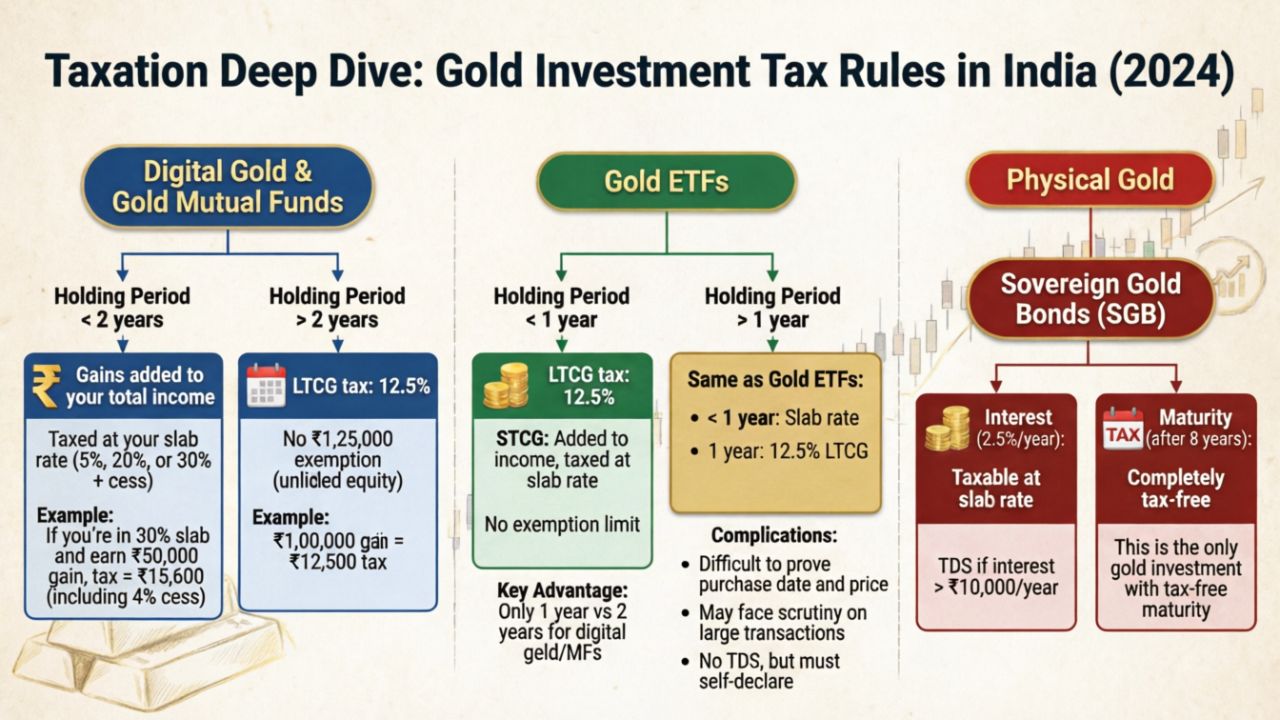
Understanding gold taxation can save you lakhs of rupees. Here’s the complete breakdown:
Digital Gold & Gold Mutual Funds
Holding Period: < 2 years
- Gains added to your total income
- Taxed at your slab rate (5%, 20%, or 30% + cess)
- Example: If you’re in 30% slab and earn ₹50,000 gain, tax = ₹15,600 (including 4% cess)
Holding Period: > 2 years
- LTCG tax: 12.5%
- No ₹1,25,000 exemption (unlike equity)
- Example: ₹1,00,000 gain = ₹12,500 tax
Gold ETFs
Holding Period: < 1 year
- STCG: Added to income, taxed at slab rate
Holding Period: > 1 year
- LTCG tax: 12.5%
- No exemption limit
- Key Advantage: Only 1 year vs 2 years for digital gold/MFs
Physical Gold
Same as Gold ETFs:
- < 1 year: Slab rate
-
1 year: 12.5% LTCG
Additional Complications:
- Difficult to prove purchase date and price
- May face scrutiny on large transactions
- No TDS, but must self-declare
Sovereign Gold Bonds
Interest (2.5%/year):
- Taxable at slab rate
- TDS if interest > ₹10,000/year
Maturity (after 8 years):
- Completely tax-free
- This is the only gold investment with tax-free maturity
The Verdict: Which Method Should You Choose?
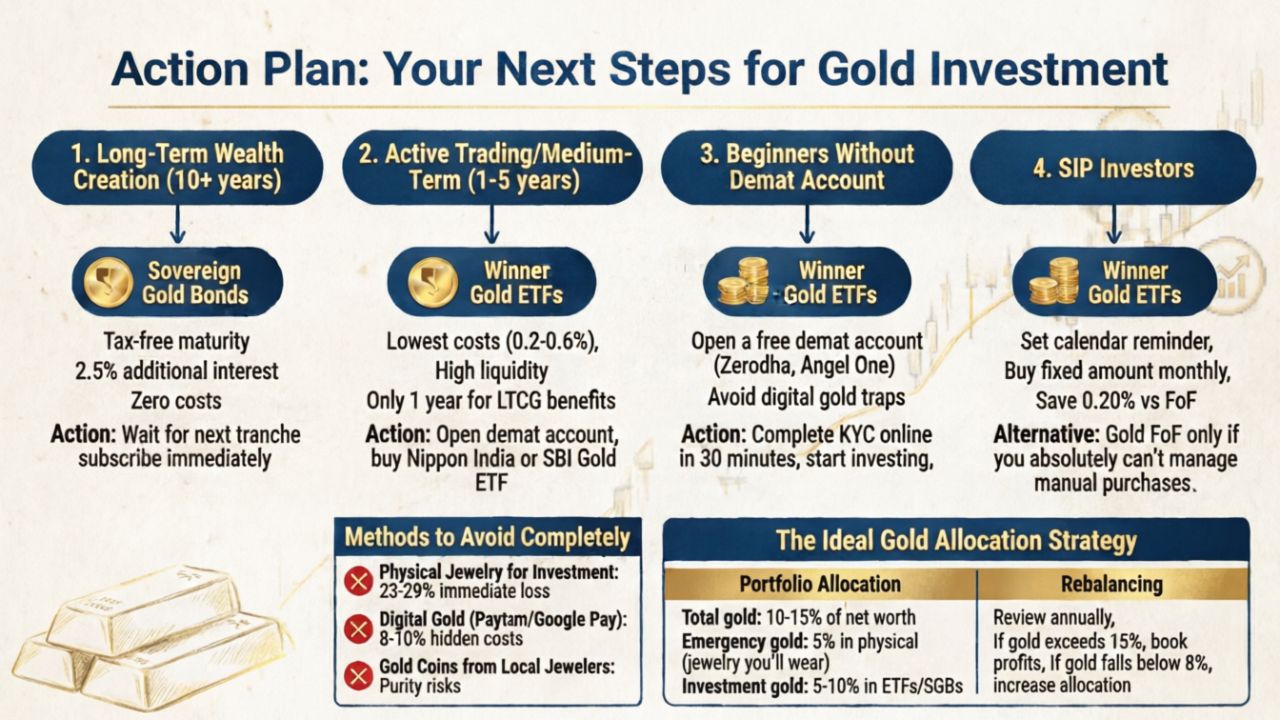
Best for Different Investor Profiles
1. Long-Term Wealth Creation (10+ years): Winner: Sovereign Gold Bonds (when available)
- Tax-free maturity
- 2.5% additional interest
- Zero costs
- Action: Wait for next tranche, subscribe immediately
2. Active Trading/Medium-Term (1-5 years): Winner: Gold ETFs
- Lowest costs (0.2-0.6%)
- High liquidity
- Only 1 year for LTCG benefits
- Action: Open demat account, buy Nippon India or SBI Gold ETF
3. Beginners Without Demat Account: Winner: Gold ETFs (still)
- Open a free demat account (Zerodha, Angel One)
- Avoid digital gold traps
- Action: Complete KYC online in 30 minutes, start investing
4. SIP Investors: Winner: Gold ETFs with manual SIP
- Set calendar reminder
- Buy fixed amount monthly
- Save 0.20% vs FoF
- Alternative: Gold FoF only if you absolutely can’t manage manual purchases
Methods to Avoid Completely
❌ Physical Jewelry for Investment: 23-29% immediate loss ❌ Digital Gold (Paytm/Google Pay): 8-10% hidden costs ❌ Gold Coins from Local Jewelers: Purity risks
The Ideal Gold Allocation Strategy
Portfolio Allocation:
- Total gold: 10-15% of net worth
- Emergency gold: 5% in physical (jewelry you’ll wear)
- Investment gold: 5-10% in ETFs/SGBs
Rebalancing:
- Review annually
- If gold exceeds 15%, book profits
- If gold falls below 8%, increase allocation
Action Plan: Your Next Steps
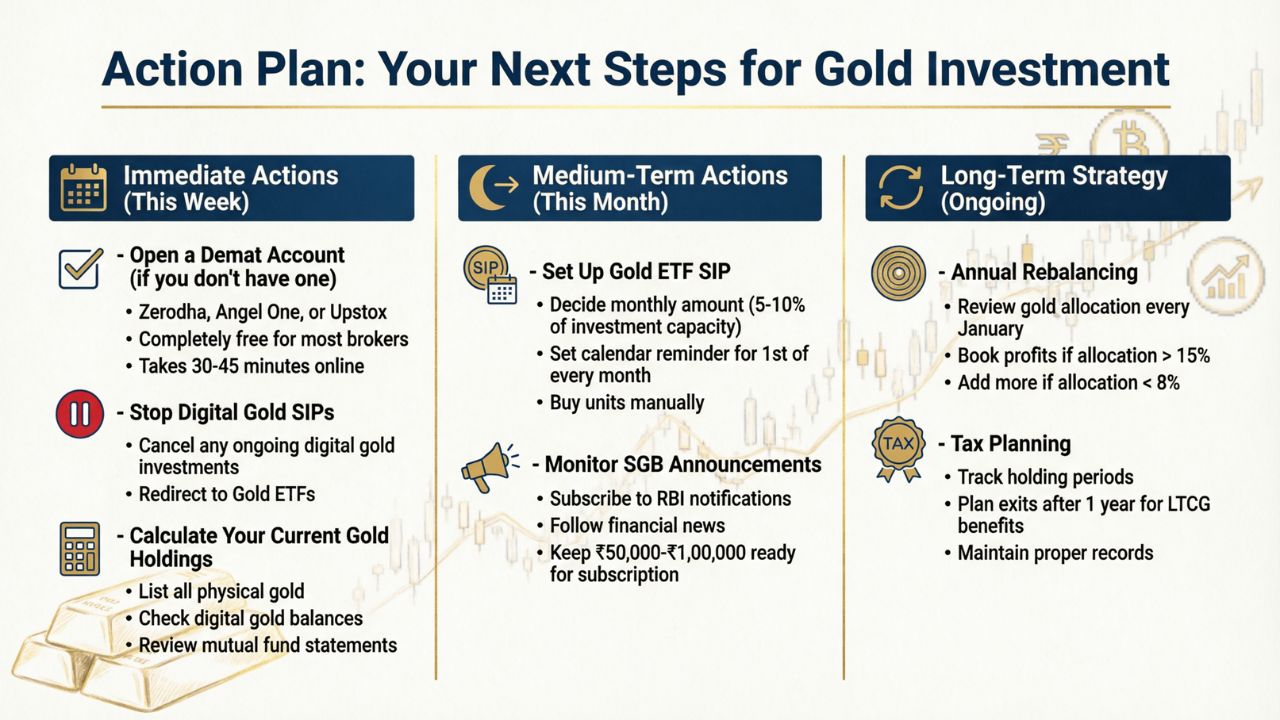
Immediate Actions (This Week)
- Open a Demat Account (if you don’t have one)
- Stop Digital Gold SIPs
- Cancel any ongoing digital gold investments
- Redirect to Gold ETFs
- Calculate Your Current Gold Holdings
- List all physical gold
- Check digital gold balances
- Review mutual fund statements
Medium-Term Actions (This Month)
- Set Up Gold ETF SIP
- Decide monthly amount (5-10% of investment capacity)
- Set calendar reminder for 1st of every month
- Buy units manually
- Monitor SGB Announcements
- Subscribe to RBI notifications
- Follow financial news
- Keep ₹50,000-₹1,00,000 ready for subscription
Long-Term Strategy (Ongoing)
- Annual Rebalancing
- Review gold allocation every January
- Book profits if allocation > 15%
- Add more if allocation < 8%
- Tax Planning
- Track holding periods
- Plan exits after 1 year for LTCG benefits
- Maintain proper records
Common Mistakes to Avoid
Mistake #1: Chasing Short-Term Price Movements
Gold is a long-term asset. Don’t try to time the market.
Solution: Stick to SIP approach, invest consistently regardless of price.
Mistake #2: Ignoring Costs
A 1% difference in costs compounds to 20-30% lower returns over 20 years.
Solution: Always check expense ratios, avoid high-cost products.
Mistake #3: Over-Allocation
Putting 30-40% in gold because “gold always goes up.”
Solution: Limit gold to 10-15% of portfolio. Gold doesn’t generate cash flow.
Mistake #4: Mixing Investment with Consumption
Buying jewelry and calling it investment.
Solution: Separate wearing gold from investment gold. Be honest about purpose.
Mistake #5: Not Understanding Taxation
Selling before completing 1-2 years and paying 30% tax instead of 12.5%.
Solution: Track purchase dates, plan exits strategically.
Conclusion: Gold Investment India
Gold investment doesn’t have to be complicated or expensive. The key is to:
- Avoid high-cost products (digital gold, jewelry for investment)
- Choose low-cost ETFs (0.2-0.6% expense ratio)
- Wait for SGBs when possible (best option)
- Hold for long term (minimum 3-5 years)
- Stay disciplined (regular investing, no timing)
Your action plan is clear:
- Stop investing in digital gold immediately
- Open a demat account this week
- Start Gold ETF SIP from next month
- Wait for SGB announcement
- Review and rebalance annually
Remember, the best gold investment is the one you understand, can afford, and will hold for the long term. Don’t let perfect be the enemy of good—start with Gold ETFs today while you wait for SGBs to return.
Your wealth-building journey in gold starts now. Make it count.
Disclaimer: This article is for educational purposes only and should not be considered as investment advice. Please consult with a SEBI-registered financial advisor before making any investment decisions. Past performance is not indicative of future returns. Gold prices are subject to market risks.









Leave a Comment