


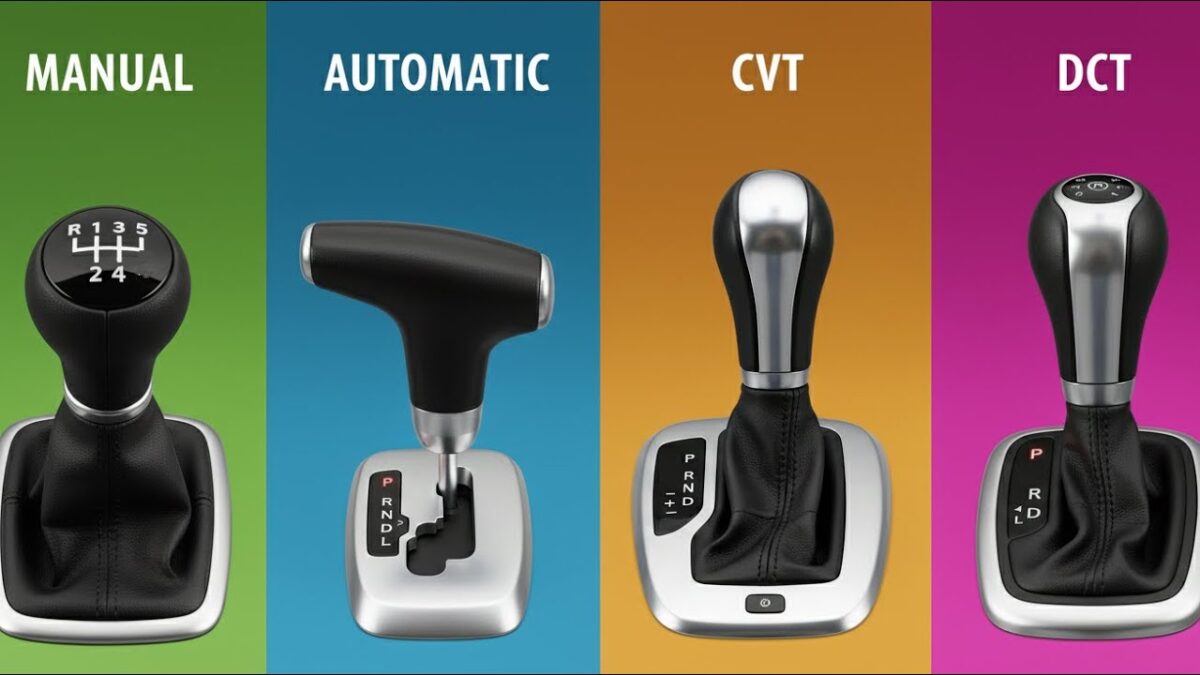


The automotive market offers a bewildering array of transmission systems today. From traditional Manual Transmissions (MT) to sophisticated Dual-Clutch Transmissions (DCT), the choices can create significant confusion for car buyers. Which Car Transmission Types are best? Which offers the most reliability? Which delivers superior performance? And crucially, which has the most affordable maintenance?
This comprehensive guide will eliminate your confusion by exploring all major transmission types in detail. We’ll examine how each system works, its advantages and disadvantages, and provide a detailed comparison based on complexity, cost, maintenance, reliability, and performance.
Understanding Transmission Systems: The Basics
Before diving into specific types, it’s essential to understand that transmission systems fundamentally fall into two categories: Manual and Automatic.
A transmission’s primary function is to transfer power from the engine to the wheels while allowing the engine to operate efficiently over a range of speeds. Proper transmission maintenance can significantly impact your driving experience, fuel efficiency, and long-term ownership costs.
Manual Transmission (MT): The Traditional Choice
How It Works
A manual transmission, also known as a stick shift, requires no introduction. It’s the oldest and most straightforward transmission system, invented by a French engineer in the 1890s. The system consists of:
- Gearbox with different-sized gears
- Clutch that connects and disconnects the engine from the gearbox
- Clutch pedal for engaging and disengaging the clutch
When driving a manual transmission vehicle, you press the clutch pedal to disengage the clutch, shift gears using the gear lever, and then release the clutch to re-engage power transmission. This process requires matching the engine RPM with the gearbox RPM for smooth shifting.
Advantages
✓ Lower initial cost – Manual transmissions are significantly cheaper to manufacture
✓ Better fuel efficiency – Direct mechanical connection minimizes power loss
✓ Lower maintenance costs – Simpler design means fewer components to fail
✓ Higher reliability – Proven technology with decades of refinement
✓ Greater driver control – Complete command over gear selection
✓ Engaging driving experience – Many enthusiasts prefer the connection
Disadvantages
✗ Learning curve – New drivers struggle with clutch control
✗ Traffic fatigue – Constant shifting in stop-and-go traffic becomes irritating
✗ Hill driving challenges – Requires skill to prevent rollback
✗ Driver-dependent performance – Efficiency depends on driver skill
Automatic Transmission (AT): The True Automatic
How It Works
Automatic Transmission was the first proper automatic system, eliminating the need for a clutch pedal. Instead of a clutch, AT uses a torque converter – a fluid-based coupling system consisting of:
- Pump connected to the engine
- Turbine connected to the gearbox
When the engine’s crankshaft rotates, it spins the pump, which pressurizes transmission fluid to rotate the turbine, transferring power to the gearbox. Unlike manual transmissions, AT uses a planetary gear system controlled by a mechatronic unit that shifts gears based on speed.
Advantages
✓ No clutch pedal – Effortless driving, especially in traffic
✓ Smooth operation – Automated shifting provides comfort
✓ Easier for beginners – No need to learn clutch control
✓ Reduced driver fatigue – Ideal for city commuting
Disadvantages
✗ Higher upfront cost – More expensive than manual transmissions
✗ Reduced fuel efficiency – The Torque converter isn’t as efficient as direct clutch engagement
✗ Higher maintenance costs – Complex system requires specialized service
✗ Power loss – Fluid coupling causes some power dissipation
✗ Slight lag – Delayed response compared to manual
Continuously Variable Transmission (CVT): The Smooth Operator
How It Works
Introduced around 1958, CVT (Continuously Variable Transmission) offers a revolutionary approach. Unlike traditional transmissions with fixed gears, CVT provides continuous gear ratio changes using a pulley and belt system:
- Movable pulleys that can increase or decrease the width
- Belt or chain connecting the pulleys
By adjusting pulley diameters based on speed, the CVT continuously varies gear ratios, providing seamless acceleration without distinct gear shifts.
Advantages
✓ Smoothest ride – No gear shift jerks
✓ Better fuel efficiency – Engine operates at optimal RPM
✓ Simpler design – Fewer components than traditional automatics
✓ Seamless acceleration – Continuous power delivery
Disadvantages
✗ Rubber band effect – Engine RPM increases before the vehicle accelerates, creating a delayed feeling
✗ Limited torque handling – The Belt system can’t handle high torque like gears
✗ Less engaging – Some drivers find it boring
✗ Belt wear concerns – Belts can wear out, requiring replacement
✗ Lower reliability perception – Generally considered less reliable than other types
Dual-Clutch Transmission (DCT): The Performance Champion
How It Works
Developed in the 1980s, DCT (Dual-Clutch Transmission) represents sophisticated engineering. As the name suggests, it uses two clutches and essentially contains two manual gearboxes:
- Gearbox 1: Even-numbered gears (2, 4, 6)
- Gearbox 2: Odd-numbered gears (1, 3, 5)
When driving in first gear, the computer pre-engages second gear in the background. When shifting, one clutch disengages while the other engages simultaneously, resulting in instantaneous gear changes. The Transmission Control Unit (TCU) manages this complex dance.
Advantages
✓ Lightning-fast shifts – Near-instantaneous gear changes
✓ Minimal power loss – Direct clutch engagement
✓ Superior performance – Preferred in sports and performance vehicles
✓ Better fuel economy – Efficient gear timing
✓ Sporty driving experience – Combines automatic convenience with manual performance
Disadvantages
✗ Highest cost – Most expensive transmission type
✗ High complexity – Two clutches mean more components
✗ Expensive maintenance – Complex system requires specialized care
✗ Lower reliability – More parts mean more potential failure points
✗ Jerky at low speeds – Can feel rough in stop-and-go traffic
Automated Manual Transmission (AMT): The Budget Automatic
How It Works
Introduced around 1997 (Ferrari pioneered its use in production cars), AMT (Automated Manual Transmission) is essentially a manual transmission with automated clutch operation.
Unlike other automatics using planetary gears, belts, or dual clutches, AMT retains a simple manual gearbox. A computer controls the clutch and shifts gears for you, eliminating the need for a clutch pedal while maintaining manual transmission mechanics.
Advantages
✓ Cost-effective – Cheaper than other automatic transmissions
✓ Easy maintenance – Simple design similar to a manual
✓ Good efficiency – Retains manual transmission fuel economy
✓ Traffic comfort – No clutch pedal for city driving
✓ Affordable automatic option – Best entry-level automatic
Disadvantages
✗ Jerky shifts – Not as smooth as other automatics
✗ Shift delay – Noticeable lag during gear changes
✗ Overtaking challenges – Delay noticeable during acceleration
✗ Rough operation – Can feel unrefined compared to AT or CVT
Intelligent Manual Transmission (IMT): The Hybrid Approach
How It Works
IMT (Intelligent Manual Transmission) represents the latest innovation. It features:
- Manual gearbox with gear lever
- No clutch pedal
- Computer-controlled clutch engagement
You shift gears manually, but the computer handles clutch operation. This isn’t a pure automatic but rather a semi-automatic transmission offering a middle ground.
Advantages
✓ Manual control – You choose when to shift
✓ No clutch pedal – Comfortable in traffic
✓ Manual-like efficiency – Fuel economy similar to manual
✓ Lower cost – Cheaper than full automatics
✓ Simple maintenance – Less complex than AT/DCT
Disadvantages
✗ Shift lag – Slight delay in gear changes
✗ Less smooth – Not as refined as other automatics
✗ Limited availability – Offered in few models
✗ Semi-automatic compromise – Neither fully manual nor automatic
Comprehensive Comparison Table
| Transmission Type | Cost | Complexity | Maintenance | Reliability | Performance | Fuel Efficiency |
|---|---|---|---|---|---|---|
| Manual (MT) | Low | Low | Low | High | Driver-dependent | Excellent |
| AMT | Low-Medium | Low-Medium | Low-Medium | Good | Average | Very Good |
| IMT | Low-Medium | Low-Medium | Low-Medium | Good | Manual-like | Very Good |
| CVT | Medium-High | Medium-High | Medium-High | Average | Smooth but lazy | Excellent |
| Automatic (AT) | High | High | High | Average | Smooth with lag | Good |
| DCT | Very High | Very High | Very High | Below Average | Best / Fastest | Very Good |
Also Check: Car Insurance Guide: Save ₹7000+ Buying Online
Making the Right Choice: Which Transmission Suits You?
Choose Manual Transmission If:
- You’re budget-conscious
- You enjoy driving engagement
- You want maximum reliability
- You don’t mind clutch operation
- You prioritize fuel efficiency
Choose AMT/IMT If:
- You want automatic convenience on a budget
- You primarily drive in city traffic
- You want easy maintenance
- You’re buying an entry-level car
Choose CVT If:
- You prioritize smoothness
- You want excellent fuel economy
- You do mostly city/suburban driving
- You prefer a relaxed driving style
Choose Automatic (AT) If:
- Comfort is your priority
- You frequently drive in heavy traffic
- Budget isn’t a primary concern
- You want proven reliability
Choose DCT If:
- Performance is paramount
- You love sporty driving
- Budget allows for premium features
- You want the fastest shifts
Also Check: How a Car Transmission Works: A Complete Driver’s Guide
Conclusion – Car Transmission Types
Each transmission type offers distinct advantages tailored to different driving needs and budgets. Manual transmissions remain the most reliable and economical, while DCT delivers unmatched performance. CVT provides the smoothest ride, AMT/IMT offer budget-friendly automatic convenience, and traditional AT balances comfort with reliability.
Consider your driving conditions, budget, performance expectations, and long-term ownership costs when making your decision. There’s no universally “best” transmission—only the best transmission for your specific needs.


Leave a Comment