





Imagine this scenario: You’re in an important office meeting, presenting to senior management. Suddenly, your phone rings—it’s your mother. You decline the call, but immediately you receive another call, followed by a WhatsApp message. You step out of the meeting to call back, and that’s when you receive the news: a medical emergency.
While everyone is safe, the hospital is demanding immediate payment. You check your account balance—it’s not enough. You need to arrange money quickly, borrow from friends, or liquidate investments. This situation could derail your entire financial planning.
According to a 2021 Finance Commission report, health expenditure is one of the primary causes of household debt and poverty in India’s low and middle-income groups. More than 70% of health spending in India is out-of-pocket, meaning people pay directly from their savings because they lack insurance coverage.

This is exactly why health insurance isn’t a luxury—it’s a necessity. Whether you’re young or old, wealthy or middle-class, health insurance is something every single person needs. While investing in stocks and mutual funds is important, health insurance is even more critical and should be your first financial priority.
What is Health Insurance and How Does It Work?
Understanding the Basics
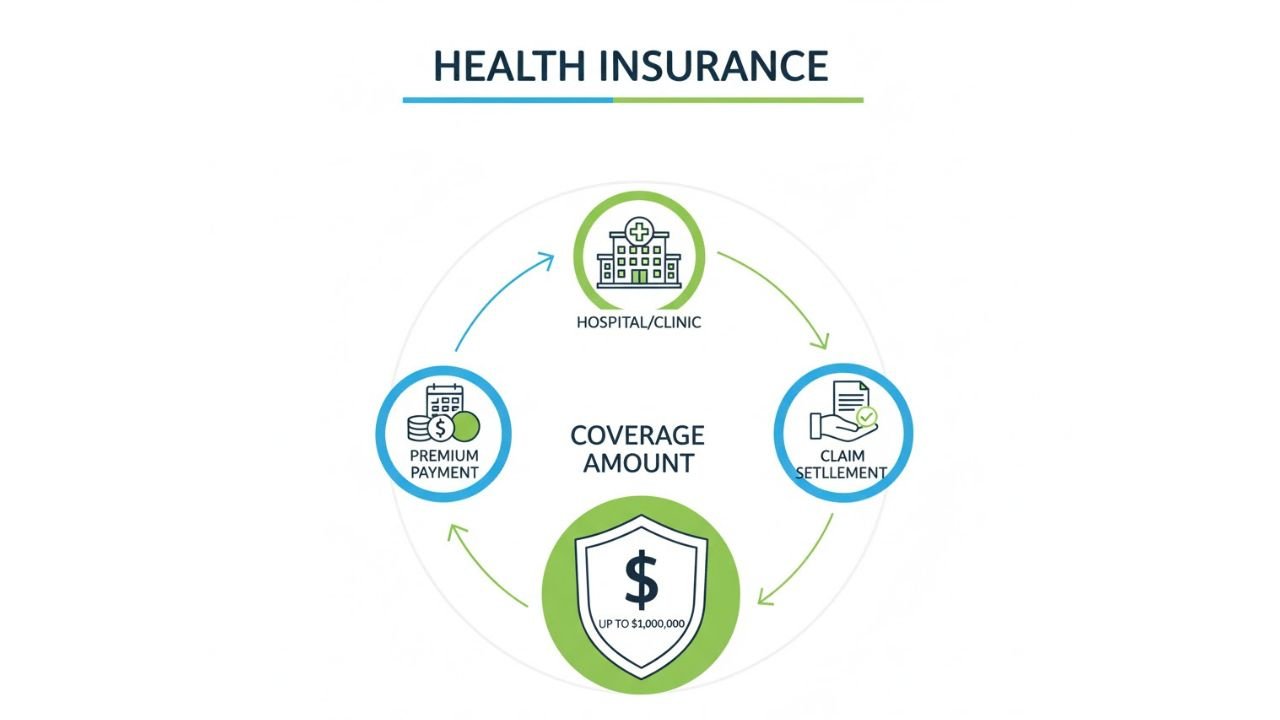
Health insurance is a contract between you (the policyholder) and an insurance company. In simple terms, you pay a regular amount called a “premium” to the insurance company, and in return, they promise to cover your medical expenses when you need hospitalization or medical treatment.
Let’s break down the key terminology:
- Premium: The amount you pay to the insurance company (monthly, quarterly, or annually) to keep your policy active.
- Claim: When you need medical treatment and request the insurance company to pay for your expenses.
- Sum Insured/Cover Amount: The maximum amount the insurance company will pay for your medical expenses during the policy year.
The Risk Pooling Concept
Health insurance works on the principle of “transferring risk from an individual to a group.” Here’s how it works:
Imagine 1,000 people each contribute ₹1,000 per month to a common fund. That’s ₹10 lakhs collected monthly. If only 5 people need medical treatment totaling ₹5 lakhs, the fund still has ₹5 lakhs remaining. The probability of everyone needing medical care simultaneously is very low.
The insurance company invests the remaining funds for future claims and continues collecting premiums. This pooled fund ensures that when you need expensive medical treatment, the money is available to cover your expenses.
For example, if you’re a 35-year-old living in Kochi, you might pay around ₹8,000 per year (₹653/month) for a ₹10 lakh health cover. If you need a surgery costing ₹4 lakhs, the insurance company pays the hospital directly—you don’t need to arrange the money yourself.
Step 1: Choosing the Right Type of Policy – Individual vs. Family
When buying health insurance, one of your first decisions is whether to purchase an individual policy or a family floater plan.
Individual Policy
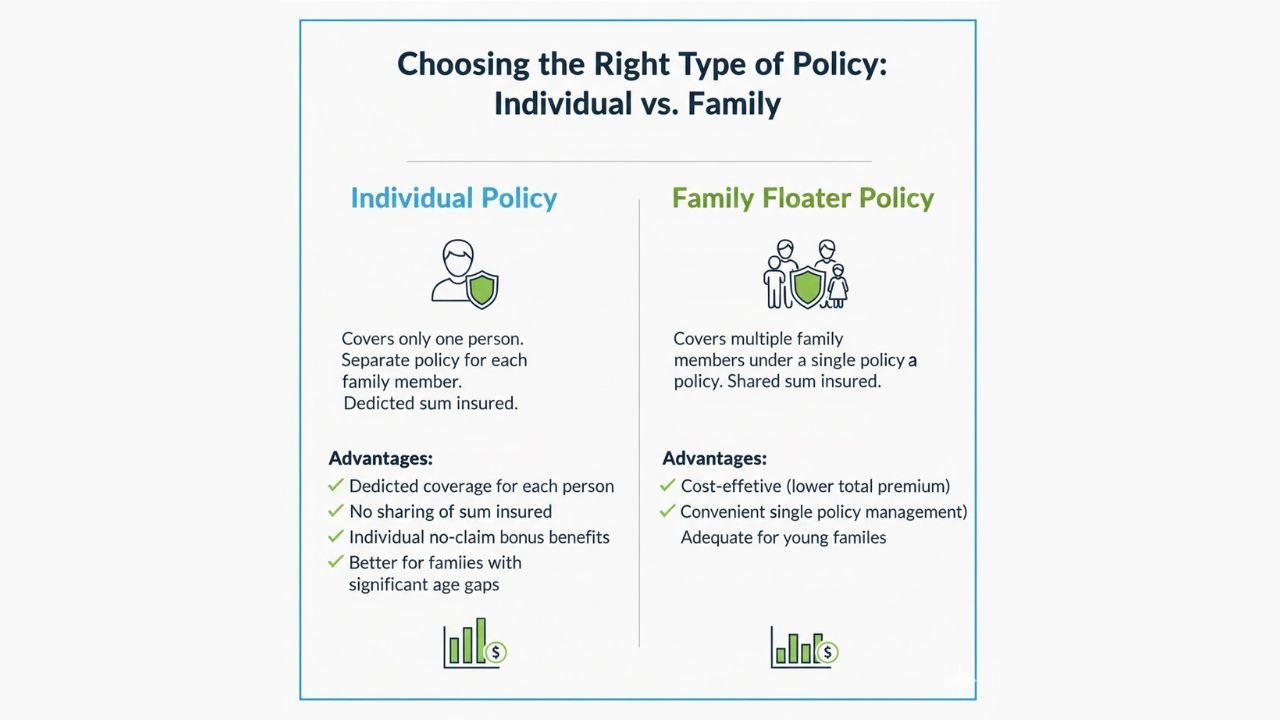
An individual policy covers only one person. Each family member would need a separate policy with their own sum insured.
Advantages:
- Dedicated coverage for each person
- No sharing of sum insured
- Individual no-claim bonus benefits
- Better for families with significant age gaps
Family Floater Policy
A family floater plan covers multiple family members under a single policy with one sum insured that can be utilized by any member.
Advantages:
- Cost-effective (lower total premium)
- Convenient single policy management
- Adequate for young families
Which Should You Choose?
Choose Family Floater If:
- You’re a young family (all members below 50 years)
- Husband and wife are of similar age
- Children are young and healthy
- No pre-existing medical conditions
Choose Individual Plans If:
- Any family member is above 50 years
- Someone has pre-existing medical conditions
- Someone requires frequent medical care
- Large age gaps between family members
Rule of Thumb: For a family of four where an individual policy would cost ₹10 lakhs per person, a family floater should be at least 2.5 times that amount—₹25 lakhs—to provide adequate coverage.
Important Warning: In family floater plans, if one person makes frequent claims, it affects the entire family’s premium and no-claim bonus. In such cases, it’s better to get an individual plan for that person and a floater for the rest.
Step 2: Determining How Much Coverage You Need
Choosing the right sum insured is crucial. Too little coverage, and you’ll pay out-of-pocket; too much, and you’ll pay unnecessarily high premiums.
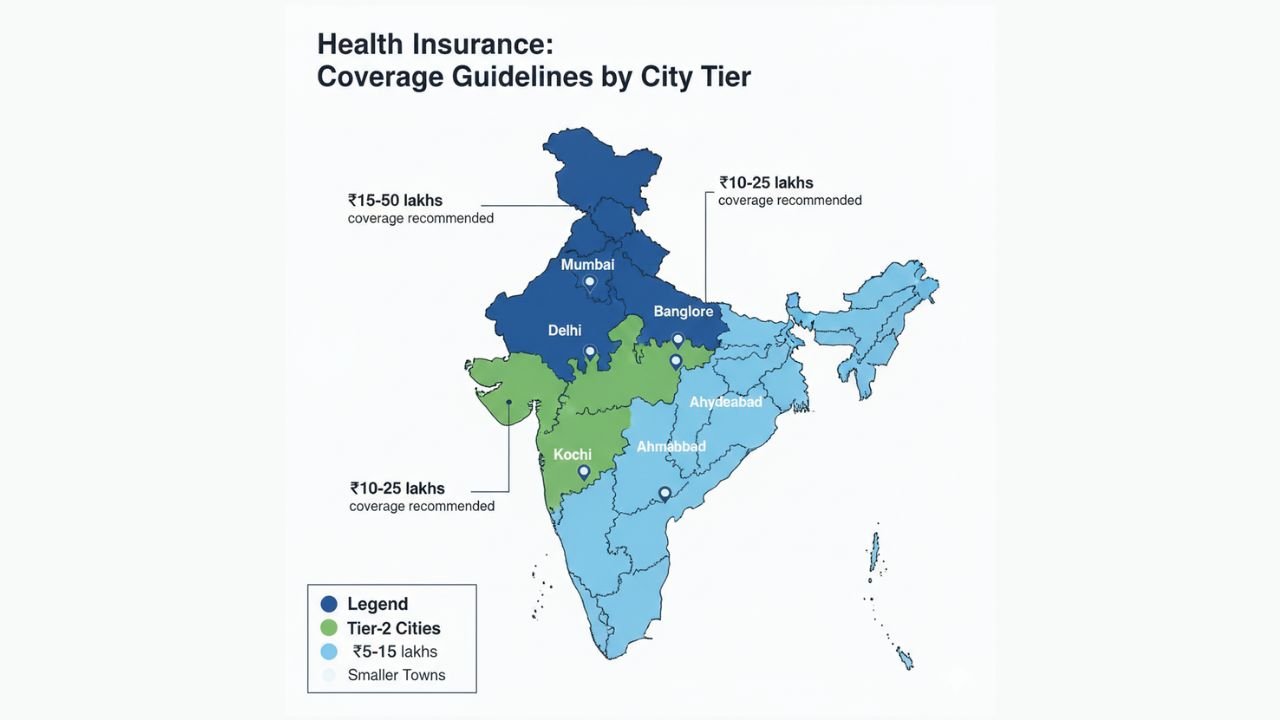
Coverage Guidelines by City Tier
Metro Cities (Mumbai, Delhi, Bangalore, Hyderabad): ₹15-50 lakhs coverage recommended
Tier-2 Cities (Kochi, Pune, Ahmedabad): ₹10-25 lakhs coverage recommended
Smaller Towns: ₹5-15 lakhs coverage recommended
Factors Affecting Coverage Needs
- Lifestyle Choices: Do you prefer general ward or private room?
- Hospital Preferences: Corporate hospital vs. local hospital
- Family Medical History: Genetic conditions to consider
- Age: Older members need higher coverage
- Existing Health Conditions: Pre-existing diseases
Real-World Example: The same surgery might cost ₹5 lakhs in a general ward but ₹25 lakhs in a luxury hospital suite. Your coverage should match your preferences.
Step 3: Essential Features to Look For
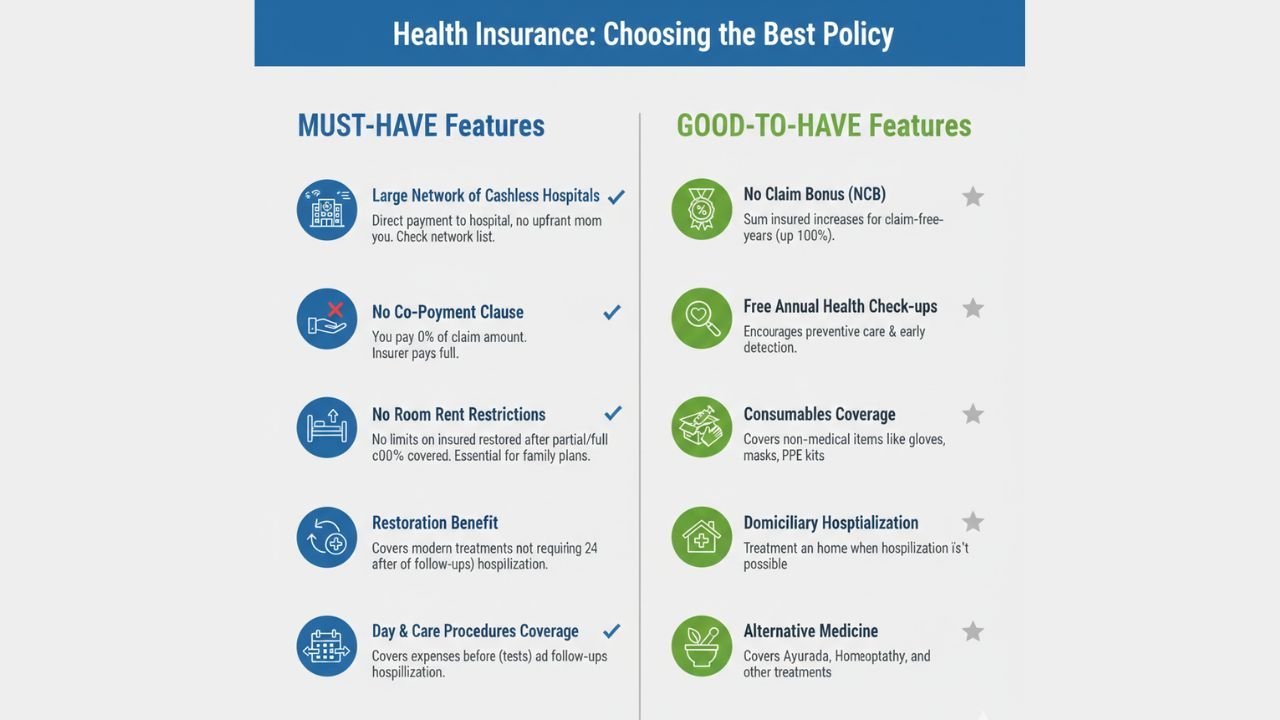
Health insurance policies come with numerous features. Let’s categorize them into “Must-Have” and “Good-to-Have” features.
MUST-HAVE Features
1. Large Network of Cashless Hospitals
Ensure the insurance company has tie-ups with hospitals near your home and workplace. Cashless treatment means the insurance company pays the hospital directly—you don’t need to arrange money first.
Check: Hospital network list before buying
2. No Co-Payment Clause
Co-payment means you pay a percentage of the claim. For example, with a 20% co-payment on a ₹5 lakh bill, you pay ₹1 lakh, and the insurer pays ₹4 lakhs.
Always choose: Policies with zero co-payment
3. No Room Rent Restrictions
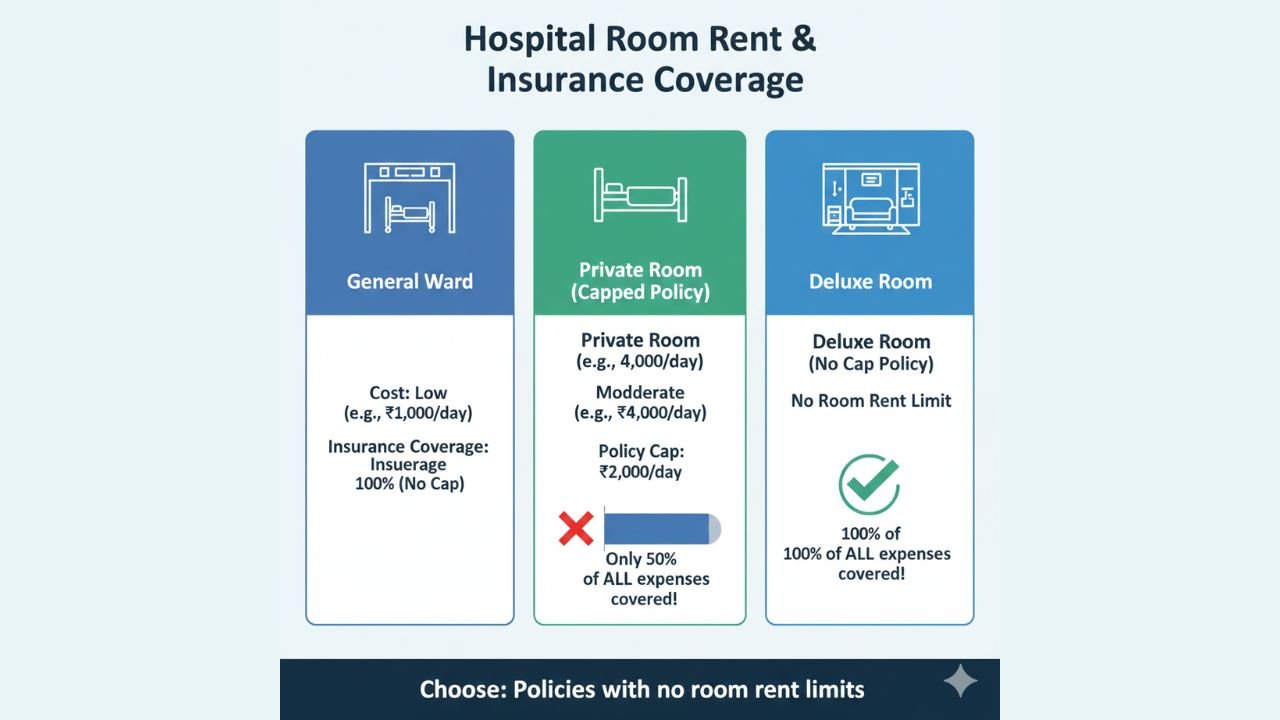
Many policies cap room rent (e.g., ₹2,000/day). If you choose a costlier room, not only is the extra rent not covered, but ALL your expenses (doctor fees, surgery costs) are proportionally reduced.
Example: If your room rent cap is ₹2,000 but you choose a ₹4,000 room, only 50% of ALL expenses will be covered.
Choose: Policies with no room rent limits
4. Restoration Benefit
If you exhaust your ₹5 lakh coverage in one claim, restoration benefit automatically restores the full sum insured for subsequent claims in the same year.
Essential for: Family floater plans
5. Day Care Procedures Coverage
Modern treatments like cataract surgery don’t require 24-hour hospitalization. Ensure your policy covers these day care procedures.
6. Pre and Post Hospitalization Coverage
Covers expenses 30-60 days before hospitalization (tests, consultations) and 60-150 days after (medicines, follow-ups).
GOOD-TO-HAVE Features
1. No Claim Bonus (NCB)
For every claim-free year, your sum insured increases (up to 100%) without increasing premium. A ₹5 lakh policy could become ₹10 lakhs after several claim-free years.
2. Free Annual Health Check-ups
Encourages preventive healthcare and early disease detection.
3. Consumables Coverage
Covers non-medical expenses like gloves, syringes, cotton, PPE kits that are usually not covered.
4. Domiciliary Hospitalization
Covers treatment at home when hospitalization isn’t possible or the patient can’t be transported.
5. Alternative Medicine Coverage
Covers Ayurveda, Homeopathy, or other alternative treatments if you prefer them.
Step 4: Selecting the Best Insurance Company
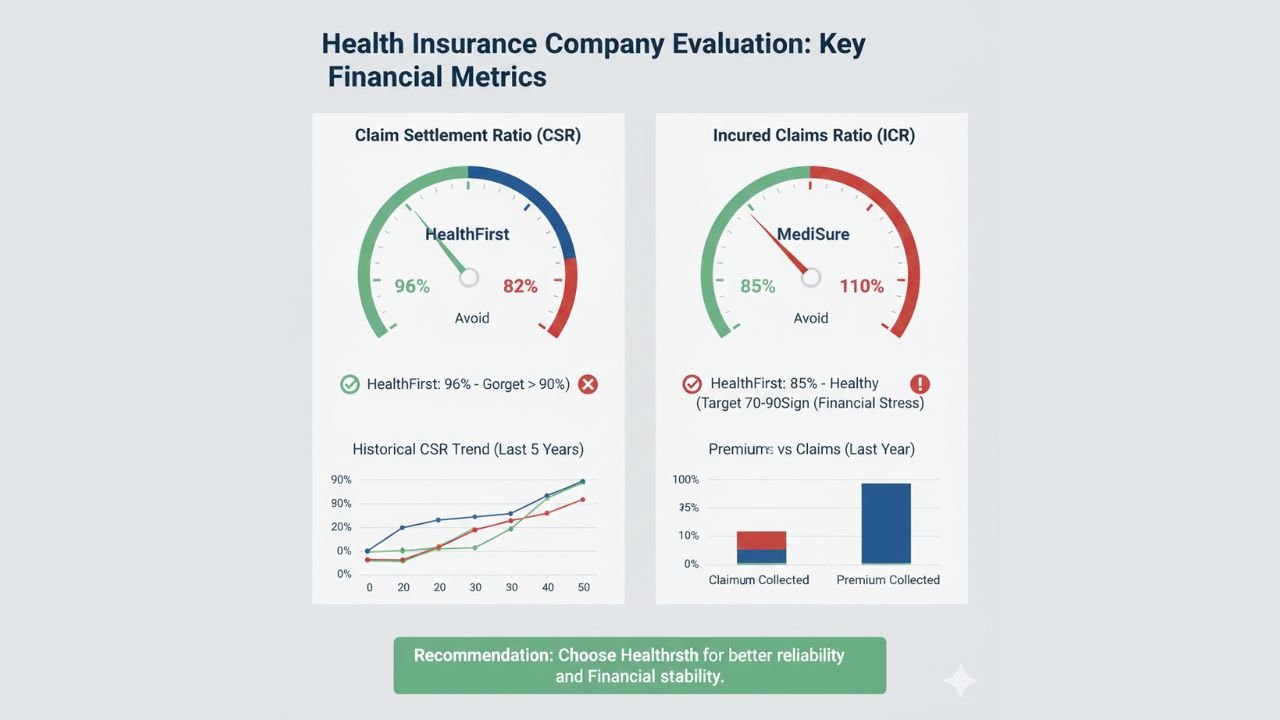
Even the best policy is useless if the company doesn’t settle claims. Use these two critical ratios to evaluate insurers:
1. Claim Settlement Ratio (CSR)
This shows what percentage of claims the company settles.
Formula: Claims Settled ÷ Total Claims Received × 100
Target: Above 90%
- 90%+ = Good
- Below 90% = Avoid
- Higher is always better
Example: If a company receives 100 claims and settles 95, the CSR is 95%.
2. Incurred Claims Ratio (ICR)
This shows how much of the premium collected is paid back as claims.
Formula: Claims Paid ÷ Premium Collected × 100
Target: 50-90%
- 50-60% minimum acceptable
- 70-90% = Healthy range
- Above 100% = Warning sign (financial stress)
Step 5: Essential Add-ons and Riders
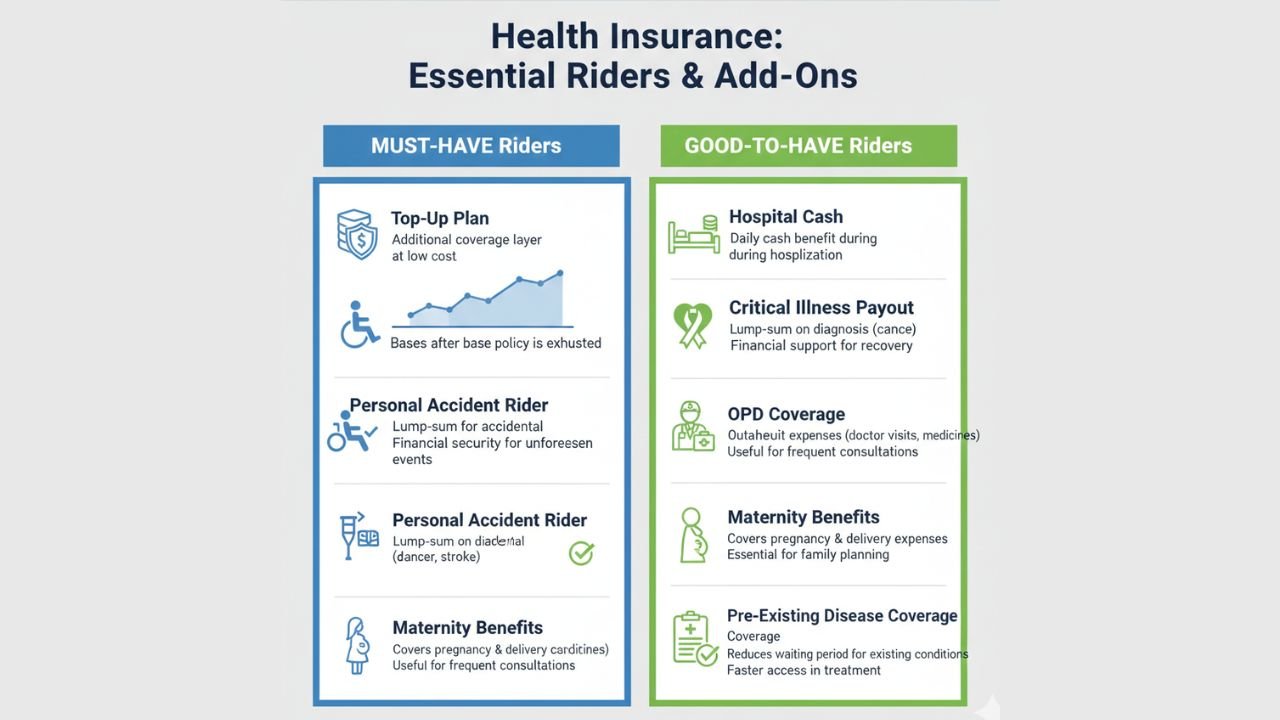
Riders are optional covers you can add for extra premium.
MUST-HAVE Riders
1. Top-Up Plan
Provides additional coverage at minimal cost.
Example: You have a ₹10 lakh base policy. Add a ₹15 lakh top-up for just ₹500-1000 extra premium. The top-up activates only after you exhaust the base ₹10 lakhs.
2. Personal Accident Rider
Provides lump-sum payment for accidental death or disability. Essential if you don’t have separate life insurance.
GOOD-TO-HAVE Riders
1. Hospital Cash
Daily cash benefit for each day of hospitalization. Ideal for daily wage earners or those without paid medical leave.
2. Critical Illness Payout
Lump-sum payment on diagnosis of specified critical illnesses (cancer, heart attack, stroke). Helps cover living expenses during treatment.
3. OPD Coverage
Covers outpatient expenses (doctor visits, medicines without hospitalization). Useful for families with young children or elderly members.
4. Maternity Benefits
Covers pregnancy and delivery expenses. Essential if you’re planning a family.
5. Pre-Existing Disease Coverage
Reduces waiting period for existing conditions like diabetes, hypertension, or asthma.
Critical Points to Remember
1. Premium Increases with Age
Expect premiums to rise annually as you age. This is normal. However, if increases are excessive, consider porting to another insurer.
2. Waiting Periods
- Initial Waiting Period: 30 days (policy won’t cover any illness except accidents)
- Specific Diseases: 1-2 years for conditions like hernia, cataract
- Pre-Existing Diseases: 2-4 years
Good News: When you port to another insurer, already-served waiting periods are carried forward.
3. Disease Sub-Limits
Some policies cap coverage for specific diseases. For example, a ₹5 lakh policy might limit cardiac treatments to ₹2.5 lakhs. Always check for sub-limits.
4. NEVER Lie on Insurance Forms
Disclose all medical conditions, smoking habits, and lifestyle factors honestly. If you lie and the company discovers it during claim settlement, your claim will be rejected—even for unrelated illnesses.
5. Understand Exclusions
Common exclusions include:
- Cosmetic procedures
- Dental treatments (unless requiring hospitalization)
- War-related injuries
- Self-inflicted injuries
- Congenital diseases
Special Considerations for NRIs
If you’re a Non-Resident Indian:
- Buy Early: Purchase health insurance for your parents in India while you’re young. Waiting periods and premiums increase with age.
- Global Purchase: You can buy policies from anywhere in the world for your family in India.
- Future Planning: If you plan to return to India, buy now to lock in lower premiums and start waiting periods.
The Bottom Line: Why You Can’t Afford to Skip Health Insurance
Health insurance isn’t about making money—it’s about peace of mind. You might pay premiums for years without claiming, and that’s actually GOOD news. It means you stayed healthy.
Remember:
- Buy early when premiums are low
- Never compromise on essential features to save money
- Choose quality over cheapest premium
- Read policy documents carefully
- Don’t wait for a health scare to buy insurance
Take Action Now
Don’t let an unexpected medical emergency derail your financial future. Here’s your action plan:
- Assess your coverage needs using the guidelines above
- Compare policies based on features, not just price
- Check claim settlement ratios
- Choose essential features and riders
- Buy the policy and secure your family’s future
Your health insurance decision today could save your family from financial catastrophe tomorrow.
Ready to buy? Start by comparing policies online, use filters for must-have features, and don’t hesitate to consult a financial advisor if needed. Remember, the best time to buy health insurance was yesterday—the second best time is now.
Did this guide help you? Share it with someone who still hasn’t bought health insurance. You might just save them from a financial crisis.










Leave a Comment